
Cart is empty
 Shop By
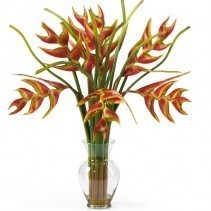
Bunch Of Heliconias
Delivery
Payment Options
Why Buy With Us
Satisfaction GuaranteedWe promise you will be amazed with your flowers!
Order Safely From Any DeviceUsing our secure payment gateway – PayPal.
Same Day DeliveryOrder before 3pm local time for same day delivery to major tourist destinations in South Bali.
Pay With PayPalPay with your PayPal account, or by using any credit card.
Description
No roses. No chrysanthemums. No orchids. Just heliconias in a glass vase with blade leaves. This is the most Bali thing we sell and it is our most popular product to Uluwatu.
$45.00 USD. Same day delivery, seven days a week, across all Bali locations including Seminyak, Canggu, Kuta, Ubud, Denpasar and Nusa Dua. Arrives in a glass vase, ready to display.
What's Inside
Six to eight hanging heliconia stems with red-orange bracts that taper to yellow-green tips. The bracts alternate down each stem in a zigzag pattern, hanging downward under their own weight. This is the pendulous variety, not the upright lobster-claw type. Each stem carries eight to twelve individual bracts and the whole structure moves slightly in a breeze because the hanging bracts act as counterweights. Long green blade leaves rise among the heliconia for vertical structure.
The vase is clear glass, classic curved shape. The stems sit in water, visible through the glass. No foam, no filler, nothing hiding inside. What you see is the entire arrangement.
Why Heliconia
Heliconia grows wild across Bali. Along roads, in temple gardens, at the edges of rice paddies, up through the jungle in Ubud and across the hillsides of Tabanan. It is the plant that visitors photograph without knowing its name. The red and orange and green against the deep tropical green of everything around it. If you've driven from the airport to Uluwatu or from Denpasar to Canggu, you've seen heliconia growing without realising it.
Putting heliconia in a vase and sending it to someone is a different statement from sending roses or chrysanthemums. Roses exist everywhere. Chrysanthemums grow on every continent. But heliconia only grows in the tropics. A bunch of heliconias in a glass vase on a table in Uluwatu says this place, this island, this is where you are right now. It is the flower that anchors you geographically. That's why it outsells roses and mixed arrangements in the clifftop villa market south of the peninsula.
Ay Ayu Owner, Sunny Florist Bali
"When tourists buy flowers they choose roses. When expats who've lived here two years buy flowers they choose orchids. When expats who've been here five years or more buy flowers they choose heliconia. I've watched that pattern play out since I opened the shop. Heliconia is the flower people graduate to once they stop comparing Bali to home and start seeing it for what it is. The villa managers in Uluwatu figured this out years ago. They put heliconia in the entrance, on the dining table, by the infinity pool. Not roses. Not orchids. Heliconia. Because guests who fly to Uluwatu didn't come to see something they could see in Sydney or London. They came for Bali."
The Hanging Bracts
The bracts on a hanging heliconia are not petals. They are modified leaves, stiff and waxy, arranged in an alternating zigzag down the stem. The actual flowers are tiny and hidden inside the bracts where pollinators find them. What you see, the red and orange and yellow-green display, is all leaf tissue. That's why heliconias last as long as they do. Petal tissue wilts in days. Leaf tissue holds for weeks.
My grandmother knew this. She used to say the temple arrangements in Gianyar lasted longer than household offerings because the priests chose heliconia and anthurium over jasmine and frangipani. Both heliconia and anthurium are modified-leaf flowers. Both outlast anything with true petals. A bunch of heliconias in water, with the stems trimmed and the water changed every few days, will hold for two to three weeks. That is not a typo. Two to three weeks from a cut flower display.
Weight and Balance
Heliconia stems are thick. Thicker than any rose or chrysanthemum stem by a wide margin. The hanging bracts are heavy. Each bract holds a pocket of water in the wild, which is how the plant feeds pollinators, and that weight carries over into a cut arrangement. A single hanging heliconia stem can weigh as much as an entire bunch of roses.
That weight creates a balance problem in a vase. The bracts hang to one side and the whole stem leans. Put six or eight stems in a narrow vase and they'll topple it within an hour. The glass vase included with this product is wider at the base than at the mouth, which lowers the centre of gravity. The blade leaves between the heliconia stems act as spacers, keeping the heavy stems separated so the weight distributes evenly rather than loading to one side.
Ay Ayu Owner, Sunny Florist Bali
"Kadek delivered a bunch of heliconias to a villa in Pecatu once and the customer called twenty minutes later saying the vase had tipped over. The table had a slight slope. With roses that slope wouldn't matter. With heliconia, two degrees of tilt is enough to bring the whole thing down because the bracts act as lever arms. After that I started testing every heliconia bunch on a tilted surface before it goes out. I lean a cutting board at an angle on the bench and place the vase on it. If it holds on the slope, it holds anywhere. If it wobbles I adjust the blade leaves or swap in a shorter stem until the weight sits centred. That board is still on my bench. It's the ugliest quality test in the shop but it's the one that matters most for this product."
Cutting and Conditioning
Heliconia doesn't come from a wholesaler wrapped in cellophane. The stems come from the same grower near Gianyar who supplies our red ginger. He grows both along the irrigation channels at the edge of his rice field, where the soil stays wet year-round. Heliconia needs constant moisture at the roots to produce stems thick enough for cutting. A dry-season plant produces thinner stems with fewer bracts.
Cutting happens early morning before the heat sets in. The stems are sliced at the base with a sharp blade, not secateurs, because the stems are too thick for most cutting tools. They go into deep water within minutes. Any delay between cutting and water causes the thick stem to seal at the base, which blocks water uptake and shortens the display life by a week or more. That's the difference between a heliconia that lasts three weeks and one that wilts in five days. The conditioning starts the moment the stem leaves the plant.
Who Sends Heliconias
Villa managers in Uluwatu, Pecatu, and Ungasan order heliconias on rotation for guest arrivals. The architectural look suits the concrete-and-timber cliff villas that define the Bukit Peninsula. Interior designers and Airbnb hosts across Seminyak and Kerobokan order them because heliconia is the one flower that looks like a design object rather than a bouquet.
International senders choose heliconias for someone who already has everything or who specifically loves tropical plants. It works for birthdays, welcome gifts, and celebrations, but the most common order note we see is "they just arrived in Bali" or "they love the island." At $45.00 USD for six to eight stems that will last two to three weeks in a glass vase, the per-day cost is lower than any rose product we sell. Roses give you four or five beautiful days. Heliconias give you twenty.
Pair with a hand-poured candle or a chocolate hamper for a full welcome package. For tropical arrangements with mixed flowers, see Farah or Alesha. For something with roses alongside tropical elements, browse the full Balinese Arrangements collection.
Care
Change the water every three to four days. Trim a centimetre from the base of each stem at each water change using a sharp knife, not scissors. The thick stems seal quickly and a fresh cut reopens the water channel. The bracts need no attention. They will hold their colour and shape for the full two to three week display. If a lower bract starts to brown after two weeks, remove it individually. The bracts above it will continue holding.
Keep in any light condition. Unlike roses, heliconias tolerate direct sun without fading. The bracts are designed to withstand full tropical sun in the wild and they handle it in a vase the same way.
Delivery
Same day delivery, seven days a week, everywhere we reach across Bali. Uluwatu, Pecatu, Ungasan, Jimbaran, and all areas. Order before 3pm Bali time for same day.
Need to change something after ordering? Call +62 813 3862 5637 during business hours (Mon-Fri 7am to 7pm, Sat-Sun 7am to 6pm) or reach us through the contact page.
Browse the full Balinese Arrangements, see our rose collection, or visit the About Us page to learn about Sunny Florist Bali.